Everything Is Connected, Not Neatly: Meadows, Le Guin, and the Ethics of Digital Governance

If you’ve ever wished for an instruction manual to explain why pulling one lever in life seems to make three others wiggle, Donella Meadows wrote the most elegant one I’ve ever encountered. Thinking in Systems is her posthumous gift — a slim but remarkably rich volume that makes complexity approachable without flattening it, honoring both the depth of the science and its roots in philosophy and folk wisdom.
This essay is for policy designers, risk leaders, and technologists who shape digital governance; it pairs Meadows’s analytic tools with Le Guin’s narrative ethics to argue for feedback-centered, adaptive systems.
Why Meadows: A Manual for Complex Life
Meadows was a scientist, environmentalist, and teacher who devoted her career to translating the arcane language of feedback loops and stock-and-flow diagrams into stories that anyone could grasp. A pioneer at MIT and one of the lead authors of The Limits to Growth, she spent her life tracing the invisible threads that bind economy to ecology, policy to people, and cause to consequence. She studied systems with one enduring question in mind: “What if we could change the rules of the game?”

The System Dynamics Group at MIT (Jay Forrester (1918-2016), Donella Meadows (1941-2001), Dennis Meadows (1942), Jorgen Randers (1945) and William Behrens III)
I’m a heavy highlighter, crosser, and annotator, especially when I love a book or stumble upon sentences too good to leave unmarked. But with this one, I had to stop myself. If you highlight everything, you are no longer reading. Better to surrender and accept that this is a book you’ll carry with you for life. Nearly every page offers distilled insight: definitions, reflections, and examples that illuminate the forces at work in everything from global climate to office politics. Thinking in Systems achieves something rare: it explains complexity in a simple way, leaving you more perceptive, not more certain.
Resisting Essentialism
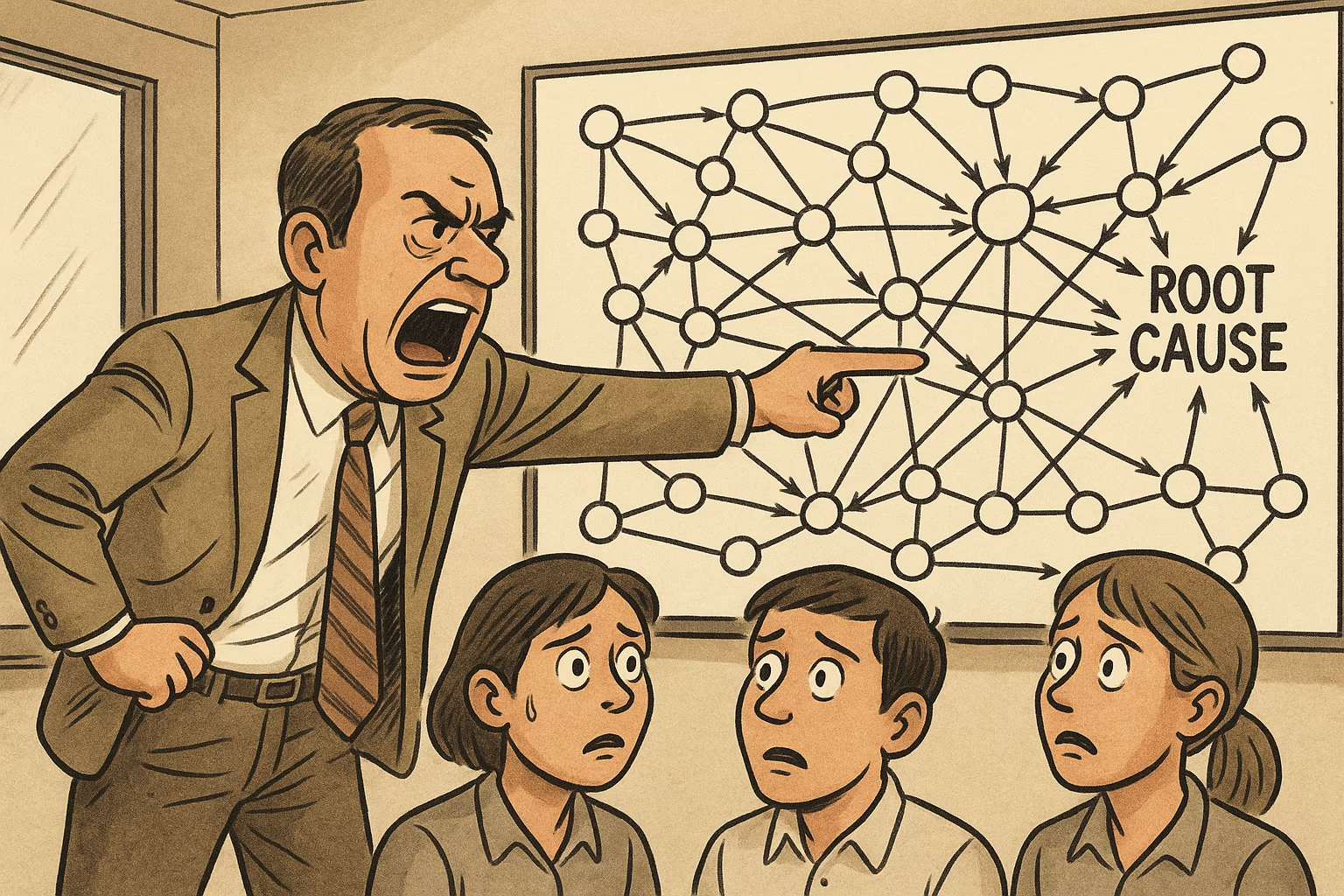
And yet, even as I tried to capture her insights in notes and highlights, I realized I was falling into the very trap Meadows warns against: the essentialist habit — our shared tendency to reduce complexity into a single cause, rule, or principle that feels neat enough to hold in one hand. If we think of essentialism as our instinct to look for one clear cause or explanation, Meadows offers a necessary corrective. She asks us to resist the urge to simplify and instead pay attention to how things connect — the feedback loops, delays, and interactions that shape behavior over time. Systems thinking doesn’t look for a single answer; it traces the relationships that make change possible. As Meadows writes in Thinking in Systems (2008): ‘Everything is connected to everything else, and not neatly.’
Our essentialist instincts crave clarity, and Meadows provides it, but not by cutting complexity down to size. Her clarity emerges from seeing patterns rather than parts. A system, she explains, isn’t just a collection of its elements but the configuration of their relationships. Once you begin to see those relationships, problems that once felt intractable reveal new contours. In her own words, “Self-organizing, nonlinear, feedback systems are inherently unpredictable… They are not controllable. They are understandable only in the most general way.”
For readers accustomed to thinking in straight lines — cause, effect, fix — this perspective can feel disorienting and counterintuitive. Meadows invites readers to think in loops rather than lines, to look for leverage points instead of culprits. “Leverage points,” she reminds us, “are not intuitive. Or if they are, we intuitively use them backward.” If Thinking in Systems teaches one enduring lesson, it’s this: clarity is not achieved by simplifying complexity, but by engaging it honestly. For those of us navigating fragile and ever-evolving digital infrastructures, the shift — from seeking control to understanding and responding to context — is practical wisdom for resilience.
Le Guin: Listening Systems
Ursula K. Le Guin, similar to Meadows, observed that the world is not a collection of parts, but a pattern of relationships. Their vocabularies and approaches differ. One offers an analytical toolbox, while the other tests these ideas through narrative fiction. Their inquiries converge on the same basic questions:
- How can we live responsibly within the systems that shape us?
- How can we transform stagnant, fragile, or unhealthy systems for the community and individuals?
The scientist, Meadows, gives us the language of feedback, delay, and leverage. The storyteller, Le Guin, translates those dynamics into lived experience. Reading Thinking in Systems and The Dispossessed side by side is like watching theory become narrative — the loop between structure and story closing in symmetry. Le Guin adds what technical models often lack: an ethical pedagogy and an emotional register that reveal how feedback feels, how dogma ossifies, and why narrative is a tool for collective recalibration.
The System and the Simmering Whole
Both writers challenge the illusion of separateness. Meadows insists that system boundaries are constructs, not realities. She says they are useful for modeling, analysis, and speculation, but are necessarily incomplete and permeable. “There are no separate systems,” she writes. “The world is a continuum.”

Le Guin makes this intuition visible through her twin worlds, Anarres and Urras. Urras’s lush, hierarchical, and seductive society is a system of positive reinforcing feedback loops: wealth begets power, power begets wealth. Anarres, the anarchist moon, is designed as a system with negative balancing feedback loops, its scarcity and mutualism dampening inequality and hierarchy. Yet both depend on each other. Anarres defines itself in opposition to Urras, and Urras needs Anarres as its mirror of moral decay. The relationship is a dynamic equilibrium. Not antagonism, but oscillation. Shevek, Le Guin’s outsider protagonist, embodies Meadows’s systems sensibility. His work on ‘Simultaneity’, exploring the connection of distant points across time and space, becomes a metaphor for interrelation and interdependence. To understand time, he must accept that causality is not linear.
Feedback, Freedom, and Fragility of Order
Both women understood that control is an illusion and that a system’s health depends on how well it can hear itself through individuals capable of describing it. On Anarres, no government dictates behavior. Instead, the society regulates itself through social feedback: criticism, labor postings, and peer accountability. These actions are negative feedback in the Meadowsian sense: self-correcting loops that dampen excess or ‘excrement’ as the inhabitants of Anarres call it. But even a balanced system can fail if its feedback becomes distorted and its rejuvenation mechanisms fail. Le Guin shows how the Anarresti ideal ossifies into dogma; public discourse narrows, and creative dissent becomes a betrayal. Information, the system’s lifeblood, stops flowing. Meadows would diagnose Anarres as a fragile system because it has lost its resilience. A system without open feedback confuses stability with health. “A system that can’t change is dead.”

Le Guin’s insight is the same: a society that suppresses feedback for unity silences the mechanisms that make it free. In both thinkers, the solution is not revolution through force but recalibration through listening. They see revolution as constant, to be reaffirmed in the acts of seeing, thinking, listening, and then doing or speaking. To understand society, Shevek must accept that freedom and constraint are not opposites but a result of mutual feedback. He must be an outsider working in, between, and across systems, building conceptual bridges within and between them. This is how the famous passage from The Dispossessed gets its deeper meaning within the context of the novel: ‘To be whole is to be part; true voyage is return.”
Leverage Points and the Ethics of Change
At the heart of Thinking in Systems is Meadows’ concept of ‘leverage points’ — the places in a system where a small shift can produce significant change. She argues that the highest leverage lies not in changing parameters or incentives, but in shifting paradigms: the mindset from which the system arises. Le Guin dramatizes this idea through Shevek’s General Temporal Theory. His discovery, which links worlds instantaneously, is not just a scientific revolution but a systemic shift. When he shares his work freely, defying both capitalist and collectivist control, he redefines the concept of value.
“The highest leverage is in changing the mindset or paradigm out of which the system — its goals, rules, feedback loops — arises.” In this sense, The Dispossessed is a narrative study of leverage. It shows that the intervention of one individual, when made at the level of ideas and relationships, can reconfigure the entire system. However ambiguous the utopias of Le Guin’s imagination may be, her message is fundamentally optimistic.
From Anarres to Algorithmic Governance
What do a 20th-century environmental scientist and a speculative novelist offer to digital governance? They offer more than we realize. Modern governance systems — especially digital ones — always stand at risk of becoming Urras reborn. They could become feedback loops of optimization and surveillance that reward stability and efficiency over adaptability. Metrics stand in for meaning; compliance becomes the proxy for trust. In such a world, both Le Guin and Meadows would warn that the map is starting to consume the territory. In governance and risk management, essentialism often hides in plain sight. It appears in post‑incident reports that demand a single root cause, in compliance frameworks that promise certainty and risk reduction, and in the belief that new policy can resolve systemic tension. These instincts are comforting, but misleading. They obscure the living dynamics of the systems we try to manage: the feedback loops, trade‑offs, and time delays that frustrate quick fixes.
Meadows offers a different posture. Systems thinking teaches us not to impose control, but to cultivate responsiveness and recalibration. In digital governance, that means designing for feedback rather than prediction, learning from adaptation rather than enforcing static compliance. It’s a mindset that prizes anticipation and observation over knee‑jerk reaction, and pattern recognition over personal blame. Examples of these patterns, as described below, may act at the level of information flows, rules, and paradigms:
- Incident investigations that map multiple contributing loops (people, process, tech) and focus on learning actions over “root‑cause” analysis and blame.
- Algorithm and KPI audits that include stakeholder councils and public feedback channels, creating balancing loops against the tendency to take metrics-as-meaning and optimization drift.
- Delay‑aware moderation policies, like properly defined periodic reviews, that acknowledge information lags and design staged interventions instead of ad hoc, brittle fixes.

Le Guin would ask: Who owns the feedback loops? Whose voices are encoded in the algorithms that represent us? Meadows would ask: Where are the delays and distortions in our information flows? How do we design systems capable not just of reacting, but of reflecting?
Systems thinking, like Le Guin’s anarchism, begins as an ethic before it becomes method: Meadows locates leverage at the level of paradigms, and Le Guin locates freedom in participatory, non-dominating relationships. It begins with the humility to admit interdependence and ‘being-part-of’ and/or ‘being-implied-in’. Our decisions reverberate through networks we cannot fully see, yet always participate in. In digital governance, this means designing for feedback, not prediction; building for learning, not control; and creating conditions for adaptation, not unalterable stability.
The Shared Grammar of Humility
What unites Meadows and Le Guin is not method, but stance. Both cultivate moral and epistemic humility in the face of the complexity of the systems we inhabit. For Meadows, humility is methodological — the recognition that models are partial and that systems will continue to surprise us. For Le Guin, it is existential — the awareness that freedom means participation, not mastery. Both reject essentialism: the tendency to categorize, define, and control reality based on a single key property or proposed value2. Instead, they invite us to engage with systems as inside-out participants, as observers who listen as much as act. If Thinking in Systems offers the tools to see, The Dispossessed offers the courage to live what we see. Together, they remind us that systems are not mechanical constructs, but moral terrains: shaped by the choices, stories, and silences of individuals.
Conclusion
The lessons of Meadows and Le Guin for digital governance can be summarized as follows: stop searching for a single root cause, for “the” fix, or “the new fad,” and instead start cultivating living systems that can learn, listen, and adapt to their environment. In governance, as in fiction, the task is not who owns or masters the system — it is to keep the conversation about what it is, what it should do, and how it should do it, active and constructive. The ethic is humility; the practice is feedback; the aim is resilience. For practitioners, a Monday-morning first step is simple: map one recurring issue as a feedback loop, surface delays and distortions, and add a small mechanism to hear and respond to it.